Search results for: “pheidole megacephala”
-

Queens and alates in Pheidole megacephala
I was fortunate enough to stumble on an emigration column of Pheidole megacephala. A long line of the ants were moving from one part of their territory to another part about 20 m away. In addition to the workers carrying larvae, pupae, and egg masses, I saw larger forms running along besides their more nimble…
-
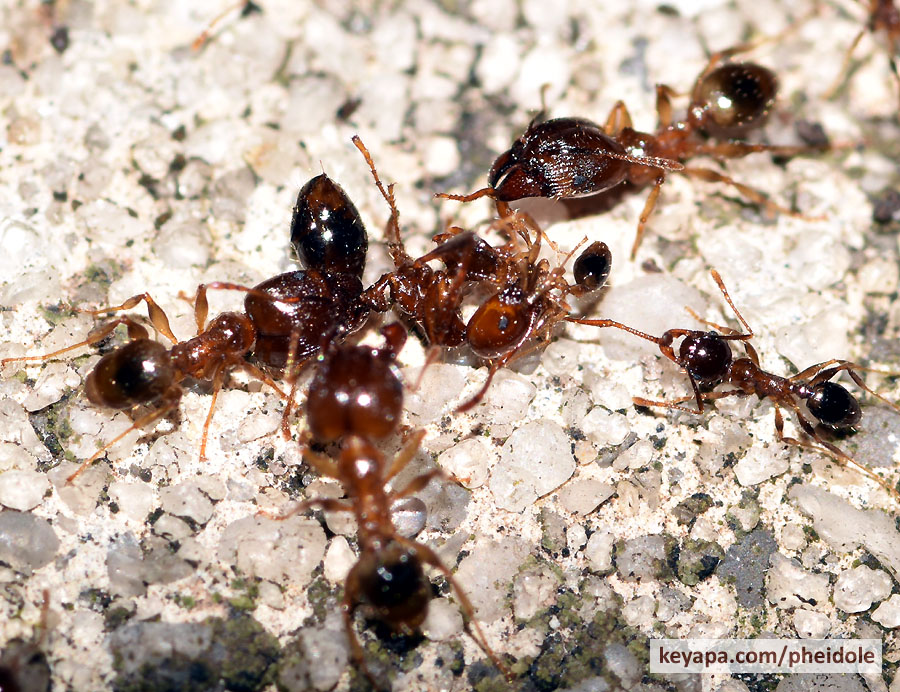
Some notes on combat behavior of Pheidole megacephala
I have been monitoring and studying a small Pheidole megacephala cluster the last month, and during that time was present during three instances of direct aggression between it and another species. I will add here a few notes on what I have observed during those three instances. (1) The main tactic of PM is one…
-

Pheidole megacephala: An Opportunity to Observe Territorial Behavior Part Deux
A few weeks back, I mapped the control of an island using baits of cookies placed along the borders of the island. The island was mostly controlled by the P. megacephala, but some baits were taken over by a small Pheidole sp, Solenopsis invicta, and a Crematogaster sp. (see image 1 below). Three weeks later,…
-

Pheidole megacephala: An Opportunity to Observe Territorial Behavior
Over the past 2 weeks or so, I have been delineating the borders of a small Pheidole megacephala cluster at a fine level of detail. The overall area covered by the species is around 1.1 ha, and I had been paying particular attention to the periphery of their control, where the density of P. megacephala…
-
A Morning Scrimmage: Pheidole megacephala vs Solenopsis invicta
Note: apologies for the images. The location was poorly lit, and the ground was wet and and dark – overall a bad time to be taking pics, and especially of tiny ants. I have been busy mapping the boundaries of a small Pheidole megacephala cluster by baiting workers out of peripheral nodes of the “super-colony”…
-
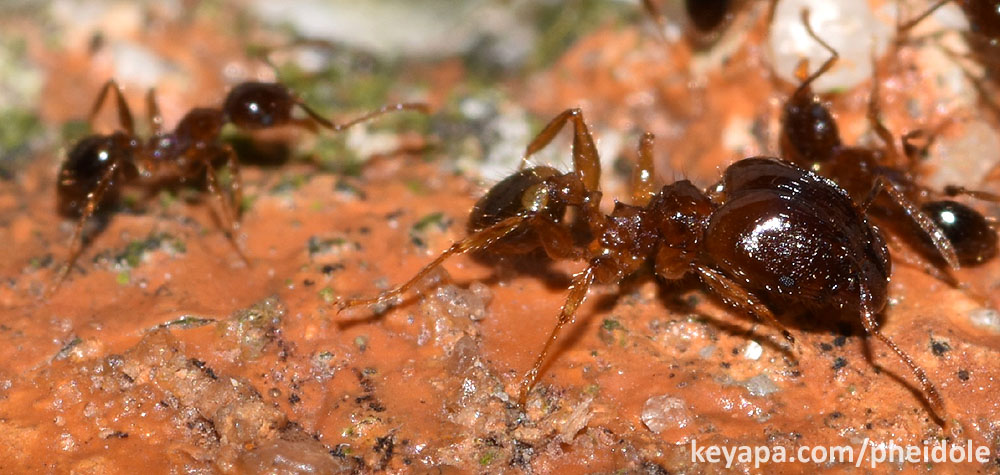
Mapping Pheidole megacephala cluster boundaries
I discovered a Pheidole megacephala cluster in a gated community here in Central Florida. It’s centered around the community’s town center, and I have been busy the last few days figuring out the boundaries of the colony. The species is unicolonial, and unlike most other ant species, it can therefore persist in a single location…
-

Pheidole confrontation!
This morning, I witnessed Pheidole megacephala workers massing around the nest of a Pheidole obscurithorax colony. The P. megacephala minors were huddling under debris and threatening the P. obscurithorax majors that confronted them. A few P. obscurithorax soldiers got too close and ended up being restrained by the P. megacephala minors, although the soldiers are…
-
Pheidole Species Listing
List of species in website: Pheidole adrianoiPheidole bilimekiPheidole dentataPheidole megacephalaPheidole obscurithoraxPheidole parva
-
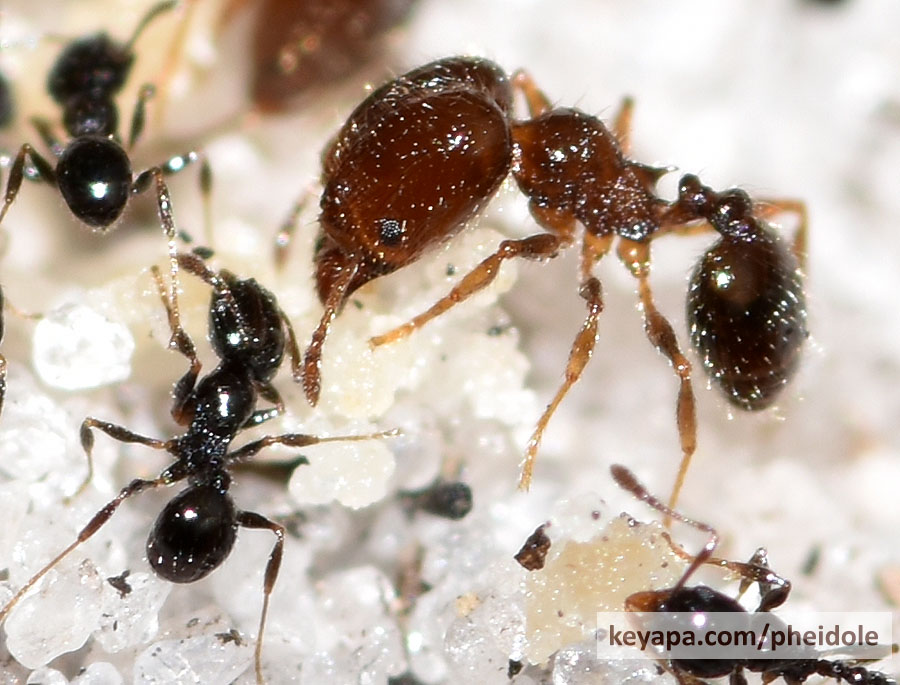
Pheidole adrianoi: Cute and Tiny Two-toned ants
Most newcomers who like ants tend to gravitate towards those species that are flashy and larger in size. My own experience also involved ants that I could readily see, whether Oecophylla smaragdina, or Solenopsis geminata, or the solitary Odontomachus spp that I sometimes saw wandering around our porch (I once called them “Black Wanderers” when…
-
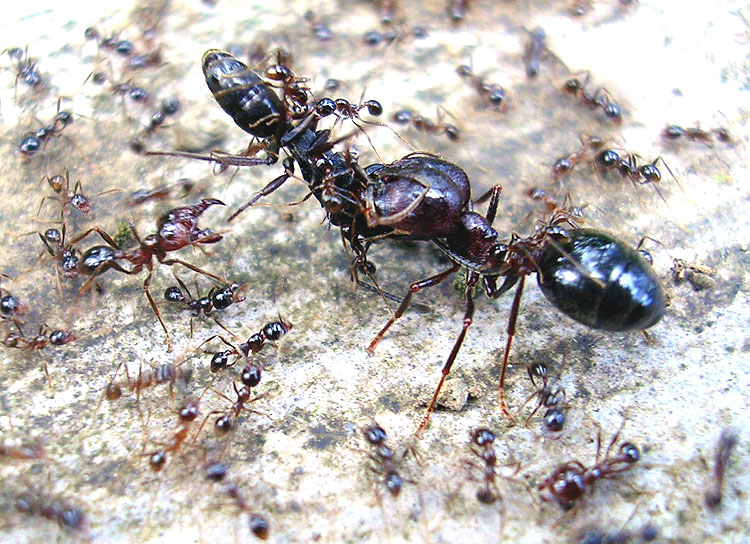
The Road to Pheidole
I’ve always been interested in polymorphic ants, whether it was the mass raiding Carebara diversa and its ilk in the Philippines, or the weird top heavy Acanthomyrmex species in the tropics. So an attraction to the mostly dimorphic Pheidole genus would have been natural. I remember when I was still a teen in the Philippines,…
-

Pheidole obscurithorax invasion!
I first saw these ants during one of my daily walks in our community here in Central Florida. I was pleasantly surprised by the find, mainly because most of the ants I had been seeing were the usual Solenopsis invicta, interspersed with the larger Camponotus that were always in danger of being stepped on as…
-

Drunken Camponotus
I can’t figure out these Carpenter Ants (Camponotus floridanus?). They are much larger than the Pheidole megacephala minors and majors, and could probably avoid them altogether or run right through their foraging lines. But in at least three instances that happened over the span of three days, the giants tried to fight and ended up…
-

Behavioral dominance vs Numerical Dominance vs Ecological Dominance
During my readings on ant behavior, there were some terms that cropped up that I was not quite sure about. Unfortunately, most of the papers seemed to assume reader familiarity with them, but my background is not ecology, so I had to search for some clarification. In the interest of perhaps helping those who also…
-

The Empire Strikes Back Part Deux: Solenopsis invicta invasion
The first part of this ongoing saga is here. Pics were taken at dusk, so may not be optimal. At dusk I returned and the Pheidole megacephala (PM) were trying to reform the trail (line) it had from the north to the node located under the vegetation (see Image 2). A line of PM from…
-
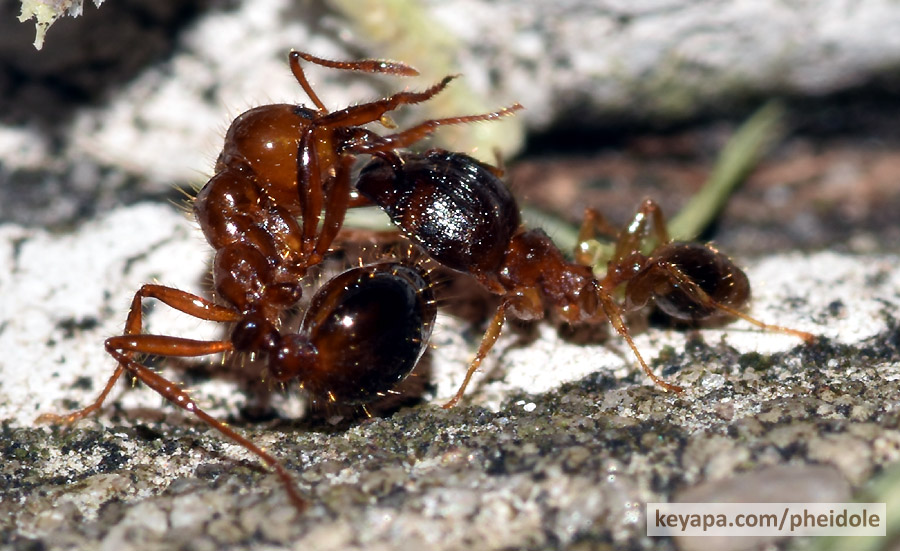
The Empire Strikes Back: Invading Solenopsis invicta Fire Ants
I have been studying and observing a nearby Pheidole megacephala cluster, which occupies an irregular area of around 1.1 ha. I usually come early in the morning (around 630 am), when the colony is starting to wind down due to the incoming heat, and then check again at dusk, when the ants start slowly pushing…